A reflective travel memoir by Joel Schaefer
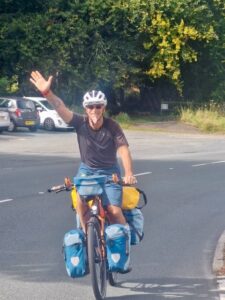 Edinburgh to Paris (2 Aug – 2 Nov 2025). The first push on the pedals always began the same way. Bags packed and balanced, water bottles filled, the Garmin fully loaded and glowing faintly. I’d raise the kickstand, feel the weight of the bike settle beneath me, and take those first few turns of the cranks—slow, deliberate, ceremonial. The sound of the wheels rolling marked the transition from stillness to motion. From the first morning in Edinburgh, that sound became a mantra.
When I set out in August, I didn’t know what ninety days and fifteen hundred miles would hold. I had only a sketch of a plan: begin in Scotland, trace the spine of the United Kingdom, cross over to France, and ride until I reached Paris. The rest would reveal itself one turn of the wheel at a time. Leaving Edinburgh, the wind pressed against me like a steady teacher testing my resolve. The canal path was lined with late-summer leaves, their green already beginning to fade. I felt clumsy on the loaded bike, fifty pounds of frame and another sixty-five of gear. But once the rhythm found me, I moved more easily. My body began to learn what my mind had forgotten. Progress is made in small increments.
But my body, still learning the rhythm of long days on the bike, had its own lessons to offer. Within the first week, I felt a sharp pain in my right Achilles tendon and then in my left. An insistent reminder that endurance is never purely a matter of will. I tried to ignore it at first, convinced that persistence would make it pass. But pain has its own form of honesty. Each morning, as I awoke, the pain returned, sharper, asking for attention. Was my tour over in the first week?
The body was speaking clearly; it needed compassion, not command. So, I took several rest days, lowered my saddle, stretched properly, and slowed my pace. In that slowing, something shifted. I realized that meeting myself where I was was the real practice. It wasn’t about conquering distance or chasing speed. It was about noticing the subtle boundaries between effort and harm. The road, I was learning, isn’t just a test of strength; it’s a mirror for the mind. We meet ourselves out there exactly as we are, and the only honest response is authenticity.
Each day unfolded as a meditation on simplicity. There were only a few questions that mattered: Where am I going? What does the weather ask of me? Where will I find food, coffee, and rest? Everything else, emails, deadlines, news fell away. The repetition, the act of packing, planning, pedaling, and unpacking, became its own kind of ritual. By the third week, I noticed my mind had begun to quiet. The chatter, the endless internal conversation that fills modern life, started to dissolve into the sound of wheels over ground and the wind at my ears. The journey was not an escape from life but a deepening of it.
By mid-August, on the Isle of Bute, I discovered the joy of stillness after motion. I spent a rest day by the sea, reading, doing yoga, and watching light move across the water. The sky in Scotland is a lesson in impermanence, sun one moment, rain the next, all of it passing like breath. The air smelled faintly of salt-spray and rain-soaked grass. My body was adapting, my mind too. I was learning that balance was not a posture to hold, but a rhythm to trust.
On the Isle of Arran, I wild camped for the first time. I pitched my tent near the shore and watched the sun drop behind the western cliffs, the light spilling gold over the water. The world seemed to pause there, no sound but the wind and the steady rhythm of the tide.
The morning of my departure began like many others: coffee, a scone, and waiting for the ferry. I was sitting in a small café, enjoying the calm start to the day, when I heard an unmistakable crunch. “Son of a b*tch,” I muttered under my breath as I realized one of my crowns had come off. This always seems to happen when I’m far from home. Now I understand the complaints about the NHS. The first two dentists I went to see told me I had to wait a month to see them. I was fortunate to find a dentist in the town of Prestwick who could help me, and unbelievably, within an hour, the crown was fixed, and I was back on the road.
Crossing from Scotland into Northern Ireland felt like stepping into a different rhythm of the same song. Belfast was bold and textured, its walls alive with stories. The murals and street art spoke of struggle and reconciliation, of identity still being shaped. I spent an afternoon wandering through the Cathedral Quarter, where color met history on every corner. One wall caught my attention, the Son of Protagoras. The piece is rich with powerful symbolism. A dove, representing peace, has been killed by two arrows—one representing the Protestant side and one representing the Catholic side of the divide. The son of Protagoras looks with anger at the Cathedral, which represents institutional religion. Art can be both a scar and a bridge.
That evening, I followed the sound of music and laughter into a pub packed with revelers. A sole guitarist led a chorus of voices that carried joy and nostalgia, mixed with humor and honesty that only the Irish seem to master. I sat in the corner; a stranger welcomed, and was offered a pint of Guinness. I listened and enjoyed the music as much as the people. Belonging isn’t always about place, but about presence.
 Leaving Belfast, I arrived in the resort town of Portaferry. I needed to wild camp again, so I had to hang out for a bit until dark. I still felt that mixture of excitement and unease that comes with sleeping where no one expects you to be. Further south, I came to the coastal town of Newcastle, nestled between the sea and the Mourne Mountains, which delighted me so much I decided to hang out for a few days.
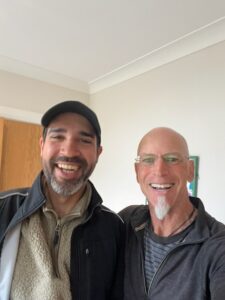
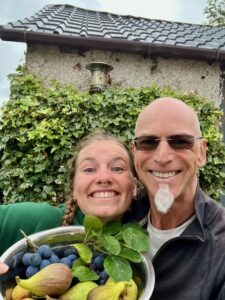 The road then carried me through rolling farmland, and I had the joy of meeting a young woman (named Tara from Munich) who was WWOOFing at the farm at which I set up my tent. We drank about 10 cups of tea together. I came to appreciate the fellowship of the road. Pedro, a Brazilian studying for the priesthood on the Isle of Man, offered me shelter one night. We shared a meal, and he told me of his adventures cycling eighteen thousand miles. “The body changes,” he said, “but the mind changes more.” That night, I fell asleep under his roof with the comfort of being embraced as a fellow traveler. Encounters like that became the hidden architecture of the journey, small acts of kindness holding everything together.
In the long stretches between towns, the solitude deepened. There is a particular silence that arises on country roads, where even the wind pauses to listen. I began to hear the small rhythms of the world: the rustle of hedgerows, the click of my freewheel, the echo of a distant church bell. In that silence, my thoughts slowed to match the pace of my wheels. There was no longer a separation between me and the motion; I had become the ride.
As I crossed into Wales in early September, the landscape began to rise sharply, demanding patience and humility. My legs ached, and my spirit sometimes followed. Headwinds tore through the valleys; rain soaked me to the bone. There were moments when I wanted to stop, to rest just a little longer, but the rhythm of breath steadied me. As in yoga, I discovered that focusing on inhalation and exhalation transformed suffering into presence. On climbs that felt endless, breath was the only thing within my control.
There were days of frustration, wrong turns, broken equipment, and the quiet loneliness of pushing through fatigue. But they passed, as all things do. I learned that impermanence isn’t just a concept to be contemplated on a cushion. It’s what keeps you moving when the sky opens up and the next town is still ten miles away. One afternoon near Snowdonia, after addressing a mechanical issue in the rain, it stopped abruptly, and a rainbow arched across the road ahead. I pulled over and stood for several minutes, watching light scatter across the wet hillsides. The air was sharp and clean, and I felt a smile rise naturally.
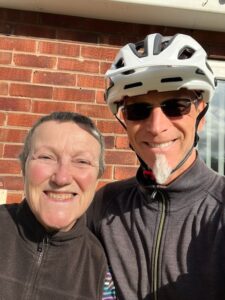 Along my journey, there were friends I was especially looking forward to seeing, both to rekindle our camaraderie and as an anchor to my journey. Liverpool and my visit with Berry and Garrett (my former neighbors) was just such a visit. I arrived in the rain like a bright interruption, and their hospitality carried warmth and comfort. It was uplifting to be in a home again, to have deep conversations, and to feel at ease. But the moment that sticks with me isn’t the coffee, the stories, or even walking in the park; it was discovering that their dog had eaten my cycling shoes, completely irreparable. If anything, it felt like a reminder that even well-laid plans, even comfortable pauses, can be chewed apart in an instant. Thank you to Amazon for getting me another pair of shoes, and I was able to continue without missing a beat.
By late September, I reached Bristol, where I took several days to rest and explore the city. Bristol’s murals exploded with color. I wandered the harborside, savoring coffee, ice cream, and the energy of the city. The simplicity of cycle touring is that one gets to be nowhere and everywhere at once. The road isn’t an escape; it’s a return to what is essential.
From Bristol, I found another anchor with Mark and Mary in Luxborough, part of the Exmoor National Park. I was thankful to be off my bike and in a home built of stone as one of the UK’s named storms decided to make itself known. So instead of battling strong headwinds and heavy rain, I enjoyed meals in the pub, walks in the country, a full English tea, intimate conversation, and sleeping in a warm bed. This was a welcome pause I didn’t know I needed.
Turning south again, I entered Cornwall. The hills grew relentless, the roads narrowing into green tunnels between hedgerows. The smell of damp soil and cow pasture clung to everything. Every descent was earned, every climb a meditation on patience. I learned to measure distance not in miles but in breaths, in the steady pulse of effort and release. In small coastal towns, I’d stop for coffee and scones, feeling the warmth of the mug seep into my hands. People asked where I’d come from and where I was going, and I found that the answer mattered less than the asking. Movement had replaced ambition; presence had replaced progress.
My destination in Cornwall was Hayle, to meet up with my climbing friends from Bermuda, Robb and Jacqui, yet another anchor. Arriving at their house felt like I had entered a spa. I enjoyed an Epsom salt bath, a sauna and a cold plunge, and refueling to my heart’s content. Their energy was easy, and conversations joyful. When we parted ways, I felt fuller; their presence had stitched a layer of steadiness into the final stretch of my journey.
By the time I reached Plymouth in early October, I had been on the road for seventy-three days. The harbor with its masts, gulls, and smell of salt and diesel marked the end of one chapter and the beginning of another. The ferry to France departed under a lavender sky, the last of England fading behind me. I arrived in Roscoff in an eerie darkness as I rode from the dock to the town. France was a challenge at first. A new language, new foods, riding on the right, I had to adapt again. I swapped scones for croissants, cortado for espresso, and experimented with crêpes. I learned to say “Je voudrais un café s’il vous plaît” and to linger. French mornings invite stillness; they resist haste.
One of my destinations was St. Malo, but on that day the weather was against me. Irrespective, I decided to make a determined push and began my ride at first light. A soft drizzle accompanied me out of town, the kind that feels more like a whisper than weather, but as the miles passed, the rain thickened and the wind gathered strength. Most of it hit me from the side, nudging rather than punishing, yet I knew that if I stopped, even for a moment, I would get cold, losing the warmth I’d managed to build. So, I borrowed resolve from my brother James, imagining him on one of his hundred-mile training rides, never slowing, never giving in to the small seductions of rest. “Be like James,” I repeated, and it worked. By early afternoon, I rolled into St. Mal,o soaked but triumphant, grateful for the heat of a hotel room and the promise of a couple of days to let my body recover. I had first learned of St. Malo from All the Light We Cannot See, and arriving there felt like stepping into the pages of that world: a tiny, hilly, walled city rising from the sea, its granite ramparts circling it like an embrace. With its rebirth following the destruction of the war, St. Malo is a symbol of French resilience and reconstruction.
The ride from St. Malo to Mont-Saint-Michel felt like a small miracle, thirty-three miles of stillness in motion. The road was flat, the air unmoving, and the countryside opened around me like a long exhale. After weeks of wind-torn days, the quiet was its own blessing. I rode through fields and small stone villages, the spire of the abbey rising in the distance like a mirage pulling me forward. It may have been the highlight of my entire tour: effortless, fluid, a day where the body remembered exactly what it was made for. But the calm held a warning in its gentleness. Low-pressure systems were sweeping toward the coast, and the next day was forecast to bring the full force of Storm Benjamin. So, I made a simple promise to myself: tomorrow, I would not ride. Tomorrow, I would walk like a pilgrim instead of a cyclist.
By evening the next day, I had changed my plans again. The wind was too strong, the forecast too hostile. I would take a train to Bayeux in the morning, a medieval town spared by the war, where I could contemplate the impact of the largest amphibious invasion in history, the courage of the soldiers, and the sacrifice of war. Standing at Omaha and Utah, and later at the American cemetery, I felt history pressing through the silence. Thousands of white crosses looked out to sea. Gratitude came easily there; words did not. These grounds are attended with a reverence that reminds visitors of both fragility and resilience, aware of how small and brief a single life is, and how precious.
 From there, I turned my wheels east toward Paris, carrying with me the reminder that sometimes the road asks for movement, and sometimes it asks for stillness. Mont-Saint-Michel and Bayeux had given me both. Movement became less about covering ground and more about listening, listening to the body, to the landscape, and to the silence. Some mornings, I rode for hours without thinking. I noticed details I might once have overlooked: the rhythm of a woodpecker echoing through a forest, the laughter of schoolchildren, the subtle shift of wind against my jacket. The ride had become a kind of moving meditation.
As October deepened, storms returned. I found myself leaning into the weather instead of resisting it. Each gust of wind, each downpour became another reminder of the fickle nature of the moment. One morning near Caudebec-en-Caux, my Garmin led me to the river’s edge. I questioned it as the nearest bridge was miles away, and into a nasty headwind. Just as I began to despair, I spotted a small ferry. Ah, the Garmin did not let me down, and the bonus was that the crossing was free: no ticket, just a smile from the crew member, the hum of the motor, and the water’s shimmer. On the far bank, I laughed aloud. The road provides what you need when you stop insisting on how it must arrive.
That evening, I checked into a quaint inn on the banks of the Seine, just outside Rouen. I was the only guest, yet the innkeeper, Bruno, insisted on preparing dinner, and I was treated to an authentic Normandy meal that both refueled my body and delighted my palate. We talked about passion and purpose, and I was struck by the quiet peace that seems to radiate from people who live in alignment with their values, just as Bruno did.
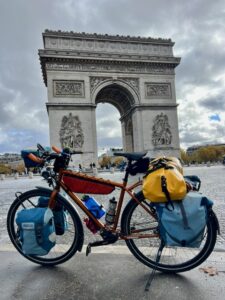
By late October, fatigue began to whisper. My legs felt leaden; the joy of motion dulled by repetition. I kept going, tracing the curves of the Seine toward Paris. The rain returned, and with it, mud and potholes that rattled every bone. On the morning of November 2nd, I rode the final nineteen miles into Paris. The sky was low, the air damp, but the anticipation carried me like a tailwind. When the Arc de Triomphe came into view, I was overcome not by happiness but by stillness. Arrival is a strange thing; it dissolves the very momentum that carried you there. I had reached my destination, yet part of me wanted only to keep moving.
My home for the next month was a tiny loft in the 7th arrondissement, one hundred and ten steps up a spiral staircase. It was so tight that I had to remove the wheels from my bike to carry it up. When I reached the top, light streamed through the skylights, and I felt, finally, both exhaustion and peace. The silence in that little apartment was almost startling after so many days of wind and road noise.
The next day, I did nothing but rest and get my bearings. Sitting in a café, I wrote in my journal, letting the hum of conversation and the clink of cups surround me. I thought about impermanence again. The way even the longest journey resolves into a single breath, a sip, a moment of awareness. The barista noticed my tired expression and brought me a small chocolate without asking. That too felt like kindness, the kind that needs no translation.
In the month that followed, I wandered Paris with no real agenda. I studied the art that had drawn me there, the brushwork of Monet, the raw tenderness of Rodin, the street art of Montmartre, the architecture, the cobblestones, the music, and the culture.
The tour was an exercise in trust—trust in my body, in my equipment, in my decisions, in strangers, in weather, in the unfolding of each day. I learned to welcome the wind, to appreciate fatigue, and to laugh at missteps. With every coffee shared, with every climb that pushed me to my limit, with every sunrise seen from a tent, I was reminded that being fully alive requires both surrender and intention. The journey was never about the miles. It was about dissolving the boundaries between effort and ease, solitude and connection, motion and meditation. On the road, I found strength by leaning into uncertainty. Plans shifted, routes changed, yet every detour carried me exactly where I needed to be.
I don’t yet know where the road will lead. But I do know this: when the time comes, I’ll feel the familiar weight of the bike beneath me, the handlebars in my hands, the breath steadying my body. I’ll push down on the pedals, and I’ll return to motion, to the practice of turning circles into stillness, of transforming spokes into Oms.