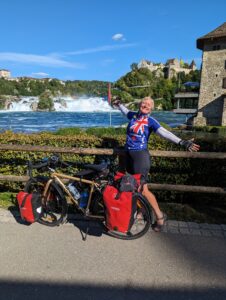
Contributor: Karen Carter
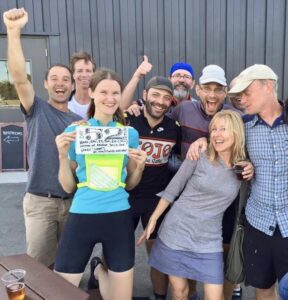 Often on road trips, my husband and I like to turn on Google Maps’ “no tolls” feature. We prefer the less direct route: the two-lane roads that wind over a mountain, skirt along a river or a rugged shoreline, meander through a dense forest, or glide past acres of farmland with herds of sheep placidly grazing or cows dozing in the grass with their calves curled up nearby. I guess you could say we prefer the road less traveled. It is these slower, softer places that allow for a quiet profundity to emerge from the seemingly unremarkable.
Over the years, we have developed relationships with like-minded friends. When we joined Warmshowers, the circle grew exponentially. Through this convivial organization that connects long-distance bike trekkers with hosts, we have gotten to know exceptional people who are riding across the country, the continent, the hemisphere, even the world.
Opening one’s home to strangers and entering in as such involves a mutual level of trust and vulnerability. And yet in the fifteen-plus years of our affiliation, never have we had a bad experience. We’ve hosted individuals, couples, and small groups. We’ve welcomed university students, environmentalists, families with teenage children, retired folks, hippies, artists, dreamers, idealists, and quirky misfits. We’ve housed, fed, done laundry for, and drunk beer with Americans, Canadians, French, Germans, Belgians, New Zealanders, Koreans, Bulgarians, Spanish, Norwegians, Argentinians, English, Irish, Scots, Dutch, and Danes. But despite their differences – largely superficial – at their core, they are the same: courageous, open-hearted, and fueled by a burning desire to see the world and learn and grow as a result. The experiences they’ve shared with us – their stories, their histories, their insights, their goals, their dreams – have changed our lives. And through spending time with them, the world has become for us, at one and the same time, bigger and smaller.
Our former guests send us amusing postcards, heartfelt letters, delightful care packages, and thoughtful texts and emails. We stay connected over WhatsApp and social media. There’s almost always a bond. We’ve even visited or traveled with some. But all stay in our memories. In the States, there was Mark from Texas, our inaugural Warmshowers guest, a trained dancer and chef who lived to ride throughout North America and Europe, stopping only to fund a few more legs of his journey by teaching ballet or cooking in restaurants. He came back a year after his first stay to ride with Tom and his bike crew from Arlington to Richmond for the 2015 Cycling World Championships. There were the three young Englishmen, recent graduates from Cambridge University, who cycled around the United States to celebrate their philosophy degrees. They carried with them a “Where’s Waldo” doll complete with glasses and a red and white striped T-shirt, which they posed in social media photos, documenting their journey.
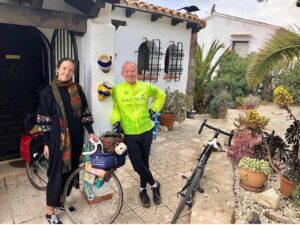
There was Nadia, a marine biology major at Plymouth University, now a scientist living and working in Antarctica. Although it was December when she stayed with us, in the mornings she’d jump in our pool or swim in the sea, although neither was warmer than 12 degrees. There was Simone from Denmark, who, as a child, was obsessed with Alaska. When she was 18, she hopped on a plane, her first time ever on US soil, where she bought an old beater bike and rode from Anchorage to Wisconsin. She fell in love in Madison, got married, and now lives in North Carolina with her husband and chickens.
There was Moon from South Korea. Upon graduating from university and completing his compulsory military service, he took his first transatlantic flight to Los Angeles. With almost no English, he bought a bike with a heavy steel frame and proceeded to pedal cross-country, starting in the Mojave Desert in July. It took him three months, and I doubt he ever stopped smiling. He rode through Missouri, where an old dairy farmer and his wife put him up for a week, feeding him hearty midwestern fare and teaching him English as well as how to milk cows. In rural Alabama, he broke down. Two grizzled men in a pick-up truck stopped and helped fix his bike. By the time he reached our house in May, he was near the end of his journey. We took him to a Memorial Day party hosted by good friends. Proud Italian Americans, they introduced him to salsiccia with grilled peppers, to Dean Martin and Frank Sinatra, and to bocce, which we played in their backyard court. Two days later, he departed for the last leg of his journey to New York City. From there, he was flying home. His panniers were covered in metal pins from every city and landmark he visited, making his heavy bike even heavier. At no time in his journey did he have with him a helmet, bike shoes, padded shorts, cycling gloves, or even a lock.
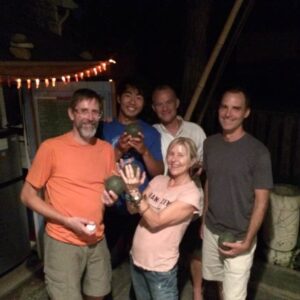
There were the three French students at the École Polytechnique who sat by our pool as we ate tapas and drank wine, and explained their intensely rigorous curriculum in a casual, offhand manner as if it were nothing. Much later, I learned that only the cream of the crop are accepted into that university, people who become Prime Minister or hold top cabinet positions. There were Mel, Ben, and their two teenage daughters from Aix-Les-Bains, France. After a serious medical scare coupled with the pandemic, they put their jobs on hold for one year, pulled the girls out of lycée, and home-schooled them on the road as they pedaled through Europe. I’m convinced the kids got a better education on the road less traveled than any classroom could have provided.
And then there was Iohan.
It’s hard to find the words to describe Iohan. He contacted Tom the usual way, through the Warmshowers app. All we knew was that he was Canadian and pedaling to South America. He needed to spend a few days in Washington, DC, to renew his visa at the Canadian embassy. The minute he entered our house, he radiated a sense of peace and calm, but also loneliness and detachment. He was a remarkable listener. He didn’t say much about his past, except that he was born in Sofia to a Bulgarian father and a Vietnamese mother. As a young teen, he was sent to live with his uncle in Mississauga, a suburb of Toronto. Although a mere 35 miles away, it was three years until he first saw the city. A few years after that, he crossed the Canadian/U.S. border to visit Niagara Falls. It was there that he caught the travel bug. I asked Iohan how he came to live with his uncle. I always ask questions of our guests: I’m curious about people; what makes them tick, who they are, how they got to be that way. As I like to say, I’m nosy but not judgmental. He gave me a vague answer. Although it was in the same slow, gentle voice I had come to associate with him, I immediately took it as a sign to drop the subject.
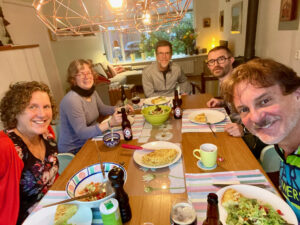
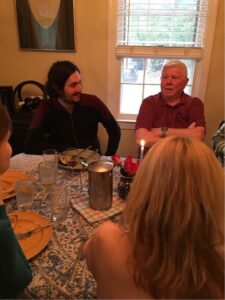
We did Iohan’s meager laundry (any bike trekker worth their salt travels as lightly as possible), and cooked vegetable-heavy meals. Although he got his visa sorted, as he was preparing to leave, we persuaded him to stay another night. The following day, Tom and his cycling friends took him on a day-long ride to show him Washington, D.C. by bike. Afterward, the group came back to our house for dinner. Another friend of ours happened to drop by, as did my parents. We pulled up extra chairs and crammed around the table. Dinner was lively. Naturally, everyone peppered Iohan with questions: Where was he headed? (Everywhere.) What was his goal? (To ride his bike and see the world.) There was laughing and talking and much trading of stories. Our friend, Paul, regaled us with tales of being at Woodstock. Who could top that? we all thought.
Then someone asked Iohan to share some of his adventures. They were nothing short of remarkable: riding alone to the Arctic Circle for his very first bike trek, carrying an inflatable kayak. He camped outdoors in record cold and paddled around the Arctic Ocean, his first time kayaking, mistakenly holding the oars backward. Along the way, he met a group of hikers. One of their friends had been swept away in a river along with their satellite phone and navigation tools. Without it, they were lost and unable to locate their food drops. Desperately, they flagged down Iohan. He was the first person they’d seen in days, and they badly needed help. Without a moment’s hesitation, Iohan made a 180-degree turn and pedaled as hard as he could for over 16 hours back to civilization to organize a rescue helicopter.
We began following Iohan’s blog, Bike Wanderer. Although English was not his first language, his grasp of its nuances, his rich and expansive vocabulary, and his effortless way with words were at once humorous, evocative, and poignant. He communicated almost instinctively on a soul-deep level. When he was on a bike, even tough times were manageable; for him, the glass was always half full. He had chosen this life of the road less traveled, and a bad day on a bike was still better than a good day conforming to societal standards. Once, while camping in the frozen tundra, a wolverine approached his tent. Not knowing what it was, he stopped to film the animal, asking in his gentle, soft voice, “Well hello there…what are you? A dog of some sort?” The wolverine simply stared for a bit into the camera, then appeared to shrug it off as no threat and ambled away. Another time, after biking hundreds of kilometers to see Mount Denali with its iconic view of the ocean, he happened to arrive on a rare cloudy day. Laughing as he filmed, he expressed how lucky he was to still be able to see the sea, even if it was only “a sea of clouds.”
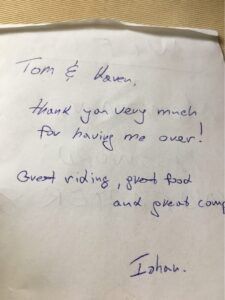
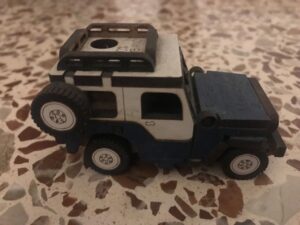 The morning he left our house, and we said goodbye, I felt a pit in my stomach. I didn’t want him to leave. Despite his intrepidness and fortitude, I sensed in him a profound vulnerability, a deep unspoken sadness. Unlike other cyclists who rode to see the world, Iohan seemed to be running from it. It was as if he needed to keep moving, and cycling was his way to do this, the more arduous the better. Perhaps he needed a certain level of physical discomfort to avoid having to sit with emotional pain. We hugged him and told him we’d always be here for him. No matter where we were or where we went, we said, ” You are always welcome in our home.” After he rode off, I went up to the guest room to strip the bed. He had already done that, leaving the sheets carefully folded. And on the dresser was a small model of a Land Rover along with a note of thanks.
In the summer of 2021, Tom and I took an 18-day road trip through Spain, Belgium, and France. Friends from Tom’s cycling group back in Virginia were flying in to meet us for the UCI Cycling World Championships. We took enough bikes so the guys could ride through Belgium for each stage of the race, while I drove the “support vehicle,” a 2007 manual Toyota Yaris with hand cranks on the back windows. It was perhaps our fifth evening of the trip. We were in Antwerp. By that time, our friend George had arrived, and we were having dinner. As we drank strong dark beer and tackled heaping plates of meat-heavy entrees, laughing at the day’s adventures and honing the itinerary for the next leg of the journey, my phone buzzed. It was a message from a friend. She had called to tell us about Iohan’s death.
In February of 2022, Tom and his friend, Ed, also a Warmshowers host, embarked on a three-week bike trek through southern Spain and Portugal. It ended up involving six to nine hours in the saddle each day, into strong headwinds, and relying on cue-sheets they wrote by hand the previous evening for direction. For the first time, they were on the other end of Warmshowers — as guests. They slept in sofa beds, often with one guy on the floor, and washed their laundry in bathroom sinks with shampoo. Even in tight quarters, their hosts were welcoming and generous: cooking hearty food, showing them around their towns, and offering advice for subsequent legs of the journey. When I told my brother about their adventures, he said, “Do you know what luxury means to me? It doesn’t mean leather car seats or expensive watches. It means being able to do what you want when you want, with the people you love. It means seeing the world, especially from a different perspective. It means not taking the easy way, the smoothly paved, two-lane, well-lit, pre-figured-out route. It means continually challenging yourself by opening yourself up to new experiences.”
It means taking the road less traveled.