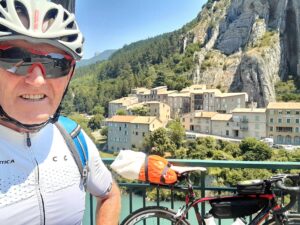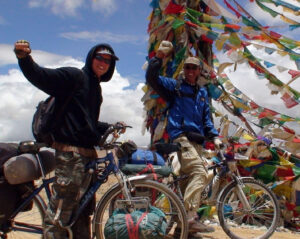
Contributor: David Chermushenko
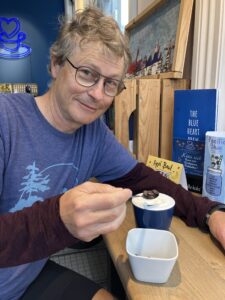 In these tumultuous times, when selfishness and fear of strangers—particularly “foreigners”—seem to be on the rise, I have just published a book (Standing with Underdogs) which includes a chapter on my experience with Warmshowers. I use this community as a symbol of the kind of goodness that still exists and which we certainly need more of.
In May 2024, my cycling friend Mike told me he was planning a major ride from Vienna to London in the autumn. He would visit his grandchildren in Vienna, cycle along the Danube, the Rhine, and over a few mountains, take a ferry across the Channel, then pedal into London in time to see his daughter, Wallis, perform in a Bernstein opera. He’d hoped to find a friend to accompany him, but the distance and time involved were making this a challenge.
When I told my wife of his plan, she suggested I join him. It seems both she and Mike’s wife were content to be rid of us. Or they believed in encouraging their 60-something spouses to take on new adventures while the body is still up to it. So began the Bad Ass Ride.
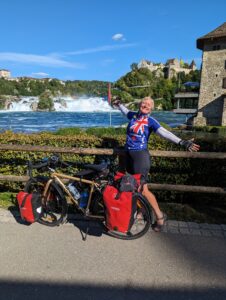
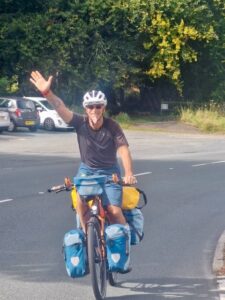
At a time when the political pendulum was swinging to the right across Europe—with all its distrust, disinformation, and xenophobia—we chose to spin through the heart of the continent. Over 35 days, we would ride our gear-laden gravel bikes over 1900 kilometres on the roads, paths, and lanes of nine countries.
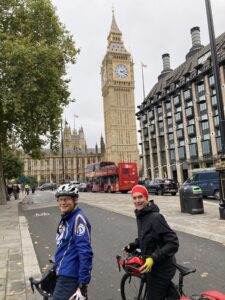 On our ride, we saw many interesting things and proved you can go far in your sixties. What we really discovered, or perhaps confirmed, was that most humans are generous, trusting and curious; and we should be all these things in return—or continue to be.
There was the potential for so many things to go wrong: bad weather, bad knees, bad advice, bad food, bad roads. Any combination could have ended our tour, or at least put a cold shower over the experience. But we were fortunate, in so many ways.
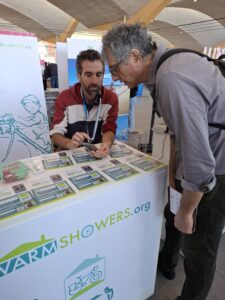
What stood out was the hospitality of the people along the way. Many were complete strangers who we found using Warmshowers: ‘a global community of touring cyclists’ whose mission is ‘to facilitate and promote safe, free reciprocal hospitality in the worldwide touring bicycling community.’
I knew of Warmshowers through Ottawa friends Anouk and Alex, who would occasionally host cyclists in their home. In August, as the date of our departure approached, I decided to join. Perhaps I could host one or two people in our home in the remaining weeks, which would give me a better sense of what this felt like and how the messaging system worked. Also, and quite important, I thought, it would give me a modest track record on the site as a host, showing I was in it for more than a free room.
Similar to Couchsurfing and related networks of travellers, Warmshowers works on trust. There are guidelines for members and a detailed Code of Conduct, both for hosts and guests, but there is no real way to police the behaviour of either host or guest. Other than—and this is key— by posting a review and offering honest (but respectful) feedback that is visible to all members. In this way, a touring rider or a host can build a kind of social credit. Poor reviews might mean nobody wants to host you or stay with you or, in extreme cases, even get your membership revoked.
There is no guarantee of perfect safety, but then, where is there ever? Our sense of security comes mostly from collective expectations, norms, and the building of trust.
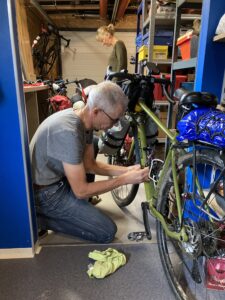 And so I became a Warmshowers member, as would Mike. Until then, we had expected our nights to be spent at some combination of family and friends’ places, small hotels, and even campgrounds. We would each carry an ultra-light tent, mattress, and sleeping bag, and would share a gas stove and pot for warming an occasional meal. What we began to realize, though, was that our opportunities for meaningful interaction with people along the way would be limited. At a hotel or campground, you may chat a little with other travellers, but rarely do you get to know local people, whether over a meal or while helping with dishes, making a bed, or tuning up your bicycle.
It dawned on us that our biggest ‘goal’ for the trip wasn’t to check off famous sites or earn boasting rights for endurance. Rather, it was to meet people, learn about their lives, communities, and concerns, and share our own stories and insights—whether that be on cycling in Canada, raising children, or the state of global affairs. For this reason above all, we became Warmshowers members, which—along with spending time with family and old friends—led to the best part of the adventure.
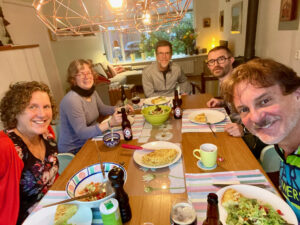
Our Warmshowers hosts were everything from single young adults to families and retired couples. The only things they had in common were generosity, curiosity, and wanting to help others see their region by bicycle. Most were cyclists, from casual to fanatical. Nicolas and Martine in France have about 10 bikes and do much longer regular rides than Mike and I. Nicolas, before heading to work in the morning, cleaned and lubricated both our bikes and re-secured one of my fenders. An older couple in Belgium weren’t bike tourers at all. It was their daughter who was, but since she had no space to host, they did so on her behalf, discovering how pleasant it was.
Our hosts tended towards ‘progressive’ politics and attitudes. They expressed dismay at the growing intolerance of differences in their own region or in adjacent ones. Naturally they also wished cycling infrastructure was better in their region or country, even when it was far superior to ours in Canada. Many were vegetarians, or were quite ready to cook vegetarian should we wish. Which leads to our other discovery: all offered a substantial dinner to be shared and lingered over. They knew we would be hungry, though they also knew we might be ready for an early night. Still, there was a mutual expectation that we would spend time chatting, even when in a few cases our limited knowledge of German or Dutch made for challenging conversation.
Mike and I understood we should make an effort to share conversation, stories and photos with the people offering dinner, breakfast, a bed and—of course—a warm shower; no matter how tired we were. On many occasions, we were sent away with our bikes in better working order than they had arrived in, and a last-minute gift of trail mix, fruit, or even a tiny bottle of schnapps made from walnuts in the hosts’ garden.
A memorable illustration of the open-mindedness of our hosts came in rural Austria. We arrived in fading light to find a double bed prepared for us. This was after they mentioned how, with their children now gone, they had several unused rooms. When our host asked if this arrangement was good for us, I quickly understood her to mean: “Do you and Mike wish to sleep together?” As in “Are you a gay couple?” Politely, I asked if we might have separate beds. I could use my sleeping bag and air mattress if that helped.
“You can help me make the bed in the room next door,” she laughed. The message I received was that they weren’t about to let a guest’s preference in love determine who could stay.
Having separate beds meant using our mattresses and sleeping bags occasionally—not every host can offer two beds. After a day of riding together, a little personal space was nice.
Why did I name our trip the Bad Ass Ride? On settling into a lovely guesthouse in Czechia, after a long ride on some sketchy forest roads, the proprietor greeted us in very fine English.
“I hope everything is to your liking,” he exclaimed.
“Oh yes,” we assured him. The room, the beds, and now our pints of pilsner.
“And have you managed to plug in your bikes?”
“Actually,” Mike explained, “we’re riding gravel bikes, without batteries.”
“Oh!” He exclaimed, raising his eyebrows. “Hard core! Bad ass!!”
We laughed. Sure, bad ass and crazy after all these years.
On our return, many friends wanted to hear about the tour, notably “What was the best part?” We independently came to the same answer: the people who hosted us. A reminder that if you hope to be welcomed as a stranger in someone’s home, be a great guest and be prepared to welcome strangers yourself.